
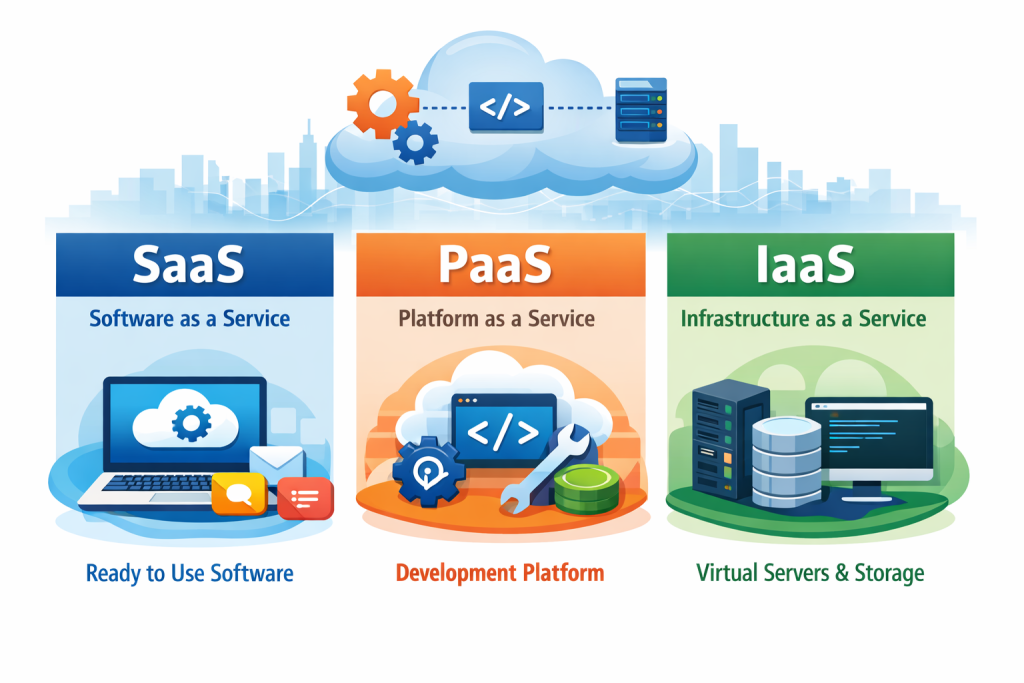
Cloud computing has transformed how businesses build, deploy, and scale technology. At the center of this transformation are three service models that often create confusion: SaaS, PaaS, and IaaS.
Understanding the real differences between them matters because each model serves a very different purpose depending on business goals, budget, and technical expertise.
SaaS, or Software as a Service, is the most familiar model for most users. It delivers fully functional software over the internet, eliminating the need to install, manage, or maintain anything locally.
Common examples include email platforms, customer relationship management systems, and collaboration tools. With SaaS, the provider is responsible for infrastructure, security, updates, and performance. This makes it ideal for companies that value speed, simplicity, and predictable costs.
The main limitation is customization, since users operate within the features and constraints defined by the provider.
PaaS, or Platform as a Service, goes a step further and is designed mainly for developers. Instead of offering ready to use software, it provides a complete cloud based environment for building, testing, and deploying applications.
This includes operating systems, databases, middleware, and development tools.
PaaS allows development teams to focus on writing code and delivering features without worrying about server management or infrastructure maintenance. It speeds up development cycles and improves productivity, but it can also create some dependency on the provider platform, which may complicate future migrations.
IaaS, or Infrastructure as a Service, offers the highest level of control and flexibility.
It provides virtualized resources such as servers, storage, and networking through the cloud. Companies using IaaS manage their own operating systems, applications, and security configurations while renting the underlying infrastructure. This model is well suited for organizations with advanced technical teams, complex workloads, or strict compliance requirements.
While IaaS enables deep customization and scalability, it also demands more expertise and operational effort.
The differences that really matter between SaaS, PaaS, and IaaS come down to control, responsibility, and speed.
SaaS focuses on convenience and ease of use. PaaS balances flexibility with faster development. IaaS emphasizes control and scalability. There is no single best option for every situation. Many modern organizations combine all three models strategically, using each where it delivers the most value and supports long term growth.