
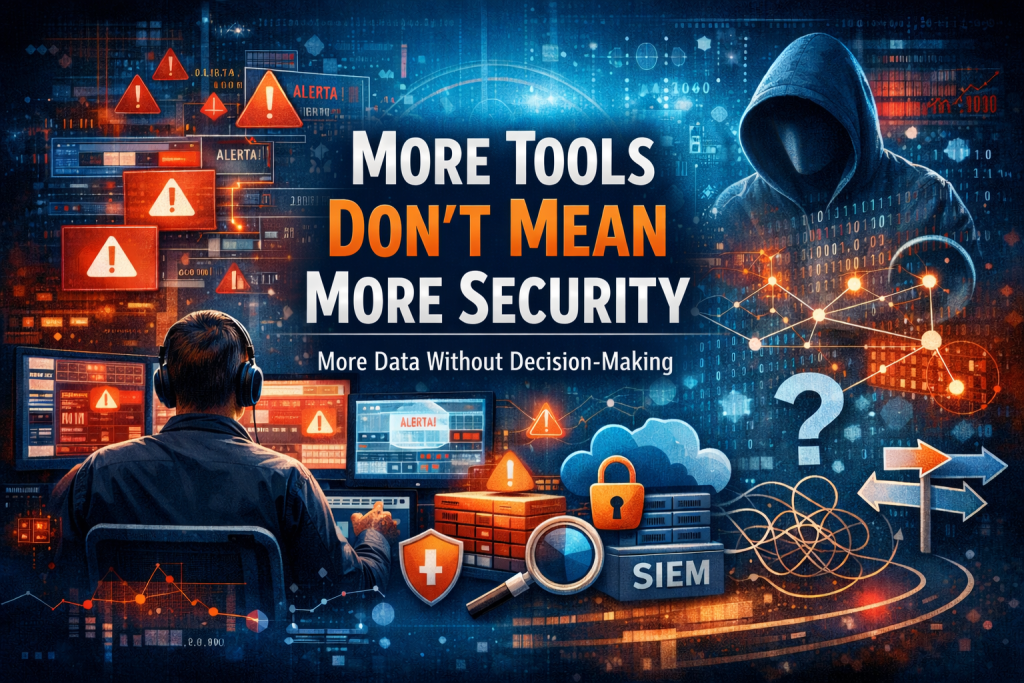
In cybersecurity, it’s easy to believe that adding more tools automatically increases protection. Firewalls, endpoint detection, SIEMs, SOAR platforms, cloud security tools, the list keeps growing. On paper, it looks impressive. In reality, more tools don’t mean more security. Instead, they often create more data without decision-making.
Organizations today are drowning in alerts, logs, dashboards, and metrics. Security teams spend more time managing tools than managing risk. The result? Missed threats, slower responses, and burned-out analysts.
This article explores why piling on security tools can backfire, how data overload weakens decision-making, and what a smarter, outcome-driven security strategy looks like.
The Myth: More Tools Equal More Security
Why Organizations Keep Buying Tools
Most companies don’t buy security tools recklessly. They do it because:
- Compliance requirements demand visible controls
- Vendors promise “complete protection”
- New threats appear faster than old ones are resolved
- Boards want reassurance through investment
Each new risk often leads to a new tool. Over time, this creates a sprawling security stack with overlapping features and disconnected data.
The False Sense of Safety
A large toolset can look mature, but appearance is not effectiveness. Attackers don’t care how many tools you own—they care how fast and accurately you respond. When tools don’t work together, threats slip through unnoticed.
Tool Sprawl: When Security Becomes Noise
Alert Fatigue Is a Real Risk
Modern tools generate enormous volumes of alerts. Many are low-quality, redundant, or poorly prioritized. Analysts are forced to:
- Triage thousands of alerts daily
- Switch between multiple dashboards
- Manually correlate events
This leads to alert fatigue, where critical signals get lost in the noise.
Data Without Context Is Useless
Logs and telemetry are only valuable if they lead to action. Without shared context like assets, identities, business impact, data remains disconnected. Teams see what happened but not what to do next.
The Real Problem: No Decision-Making Layer
Tools Collect Data, People Make Decisions
Security tools excel at collecting data. They are far less effective at turning that data into clear, prioritized decisions. When organizations lack:
- Defined incident response playbooks
- Clear ownership of decisions
- Business-aligned risk priorities
…security becomes reactive instead of strategic.
Disconnected Tools Slow Response
When tools don’t integrate, analysts must manually piece together timelines. Every minute spent switching tabs is a minute attackers can exploit. Speed, not volume, is what stops breaches.
Why More Data Can Actually Increase Risk
Delayed Detection and Response
More tools often mean:
- More alerts to review
- More systems to maintain
- More training requirements
This complexity slows response times, increasing dwell time for attackers.
Increased Operational Overhead
Every tool adds:
- Licensing costs
- Maintenance effort
- Integration challenges
Security budgets get consumed by tool management instead of risk reduction.
What Effective Security Actually Looks Like
1. Fewer, Better-Integrated Tools
Effective teams consolidate tools where possible. Platforms that share data reduce blind spots and improve visibility.
2. Decision-Centric Security Operations
The focus shifts from “How much data do we have?” to:
- What decisions must we make?
- Who makes them?
- How fast can we act?
3. Automation With Purpose
Automation isn’t about doing more—it’s about doing the right things faster. SOAR workflows should support analysts, not overwhelm them.
4. Business-Aligned Risk Prioritization
Security decisions should reflect business impact. Not all alerts matter equally. Context critical assets, users, and processes, must guide response.
Industry Insight: A Growing Concern
Research from organizations like Gartner consistently highlights tool sprawl and alert fatigue as top challenges in security operations. Mature programs focus on outcomes, not tool counts.
How to Move From Data to Decisions
Ask These Key Questions
- Which tools directly improve detection and response?
- Where do we have overlapping capabilities?
- Can analysts explain, in seconds, what action to take?
Build a Decision Framework
Successful security teams define:
- Clear severity criteria
- Escalation paths
- Pre-approved response actions
This turns raw data into confident action.
Frequently Asked Questions (FAQs)
1. Why don’t more security tools improve protection?
Because tools generate data, not decisions. Without integration and context, data overwhelms teams instead of helping them act.
2. What is tool sprawl in cybersecurity?
Tool sprawl happens when organizations deploy too many overlapping tools that don’t work together, increasing complexity and risk.
3. Is alert fatigue really dangerous?
Yes. Alert fatigue causes analysts to miss or delay responses to real threats, increasing breach likelihood.
4. Should companies reduce their security tools?
Not blindly. The goal is consolidation and integration, keeping tools that directly support faster, smarter decisions.
5. How does automation help decision-making?
When designed well, automation prioritizes alerts, enriches context, and executes routine actions, freeing analysts to focus on real threats.
6. What’s the biggest sign a security program is failing?
When teams spend more time managing tools than responding to incidents, security has become operationally ineffective.
Conclusion: Security Is About Clarity, Not Quantity
More tools don’t mean more security. They often mean more data without decision-making. True security comes from clarity, clear visibility, clear priorities, and clear actions.
Organizations that simplify their security stack, align tools with decisions, and focus on outcomes will always outperform those chasing protection through sheer volume.
In cybersecurity, less noise and better decisions beat more tools every time.